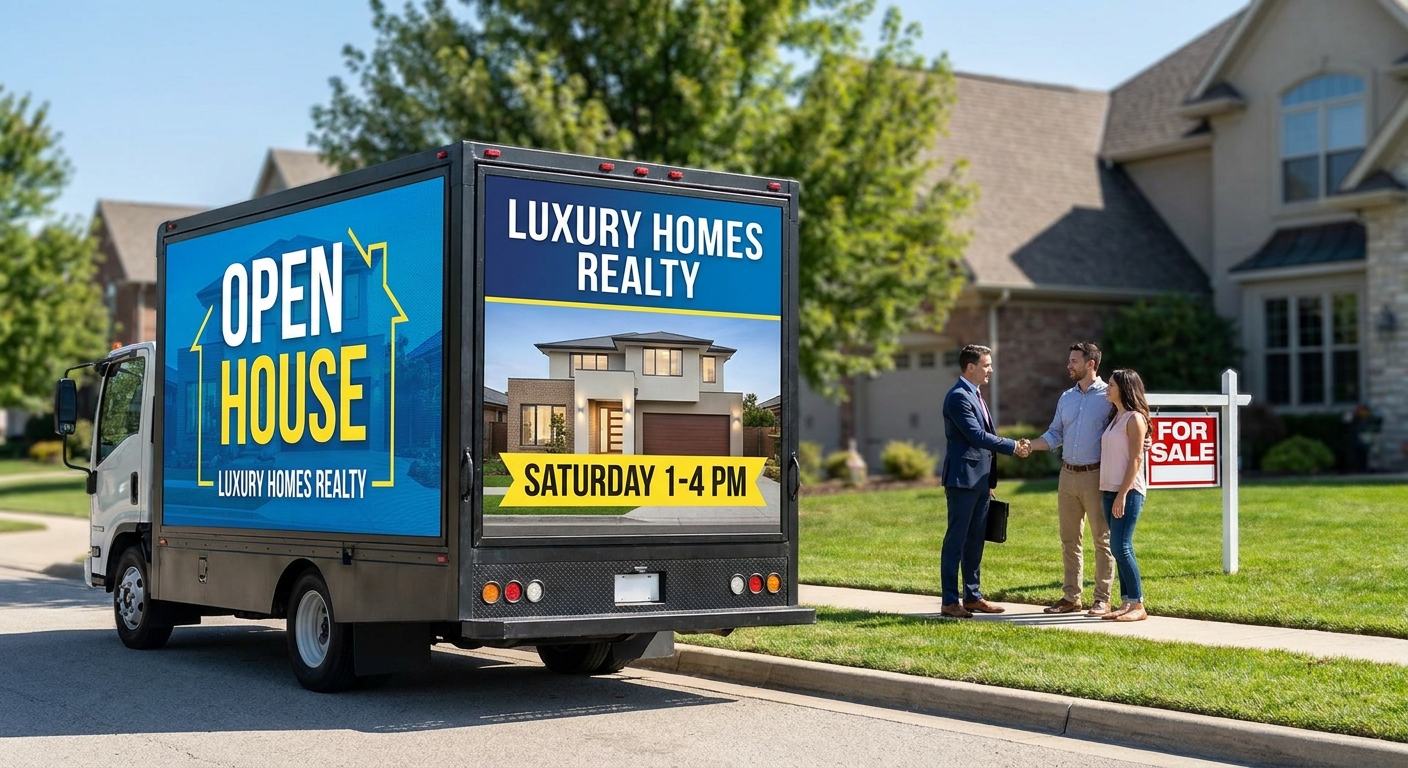
Open house weekends live or die on the first 90 seconds a buyer decides whether to pull into the driveway. Mobile billboard advertising for real estate turns every commute, school run, and highway backup near your listing into a rolling reminder that the open house starts at noon.
- Digital LED trucks parked near a listing for a 4-6 hour open house window outperform yard signs on visibility past a half-mile radius.
- Boost Outdoor Media routes trucks through Boston and New England neighborhoods with school-zone and commuter timing built in.
- Luxury listings over $1M get the most lift from mobile billboard advertising for real estate because buyers travel farther and need repeat exposure.
- Skip a static billboard lease for a single open house weekend — the truck route wins on cost per exposure and flexibility.
- Verdict: book a 4-hour Saturday loop for your next open house, not a month-long static placement.
Why this matters
A yard sign works inside a 200-foot line of sight. A digital LED truck circling a 3-5 mile radius around your open house puts the address, time, and a QR code in front of hundreds of drivers who never turn down that street.
Real estate agents in 2026 are fighting for attention against Zillow push notifications and a buyer's own scrolling thumb. A mobile billboard doesn't compete with a phone screen — it's parked at the intersection the buyer drives through on the way to brunch.
The format also solves a timing problem yard signs can't: you can run a truck loop for the exact 4-6 hours your open house is live, then park it for the next listing. No 30-day lease, no removal crew.
Who this is for
This guide is built for listing agents and brokerages running weekend open houses in Boston, the New England suburbs, or anywhere across the Northeast where a single Saturday determines whether a property sits or sells. If you're marketing a $450,000 starter home in a competitive school district or a $2.1M waterfront listing that needs buyers driving in from three towns over, the calculus below applies to you.
What to look for in mobile billboard advertising for real estate
Route control tied to your listing radius
A generic loop around downtown does nothing for a buyer 4 miles away in the next suburb. You want a route drawn around the actual commute patterns feeding your open house — main arterials, the closest highway on-ramp, the school pickup line if the listing sells on district lines.
Screen visibility in daylight, not just at night
Most open houses run between 11am and 3pm. A digital LED screen has to hold up in direct sun, not just look sharp after dark like a nightlife ad. Confirm daylight brightness before you book, because a washed-out screen at 1pm on a Saturday is money wasted.
Dwell time near high-traffic intersections
A truck that's always moving gets glances. A truck that idles at a red light for 90 seconds gets read. Look for routes that include planned stationary time at the two or three intersections closest to your listing.
Timing that matches buyer behavior, not agency convenience
Open house traffic peaks in the first hour and again 30 minutes before closing. A route that starts at 9am and wraps by noon misses the exact window buyers are deciding whether to swing by. Book the loop to run through your full open house window, not just the morning setup.
QR code and phone number legibility at 35 mph
A screen packed with listing details, price, square footage, and three photos is unreadable from a moving car. The best creative for this format is one address, one time, one QR code — legible at highway speed, not brochure density.
Booking flexibility for last-minute listing changes
Open houses get rescheduled. Weather moves showings. A vendor that requires a 30-day static commitment can't flex when your Saturday open house becomes a Sunday one. Confirm short-notice booking windows before you sign anything.
Top picks for open house routes
The commuter corridor loop — the safe pick. Routes a truck along the two or three main arterials feeding your listing during the 4pm-6pm commute the Thursday and Friday before your open house. One spec that matters: a 5-mile radius keeps the loop tight enough that drivers recognize the address when they see the yard sign in person. Boost Outdoor Media (https://boostoutdoormedia.com/) builds these routes around Boston and New England commuter patterns specifically. Buy — this is the baseline play for any listing over $400,000.
The school-zone loop — the district-line special. Circles elementary and middle school pickup zones between 2:30pm and 3:15pm on the Thursday before your open house, when parents are sitting in the pickup line with nothing to do but read a screen. One number: a 20-30 minute idle window at a single school pickup lane beats a moving loop for recall in this format. Buy if your listing sells on school district, Skip if it doesn't.
The luxury weekend loop — the wildcard. Runs a longer 6-8 hour route across three or four adjacent towns for listings priced above $1M, since these buyers travel farther and need repeat exposure across a wider area. One spec: expect the route to cover 15-20 miles round trip rather than the tight 5-mile radius used for starter homes. Consider this for anything above $1.5M; Skip it for a $350,000 condo where the buyer pool is hyperlocal.
The broker open loop — the industry-only play. Targets a shorter 2-3 hour window on the weekday broker open, when the audience is other agents rather than buyers. One number: broker opens typically run half the hours of a public open house, so the truck route should be shorter and cheaper too. Consider for high-inventory markets where getting other agents talking about the listing matters; Skip for a quiet listing with no bidding-war pressure.
The static-billboard alternative — what agents default to first. A 30-day static billboard lease near the listing costs a month's commitment for a property that might sell in one weekend. One spec: static leases lock you into a fixed location with zero route flexibility if the open house date shifts. Skip this for single-weekend open houses; it only makes sense for a brokerage running the same corridor for months.
Book your open house route
Get a route built around your listing's commute patterns before the weekend.
What to avoid
- Static bus shelter ads booked for a single weekend. The lease terms are built for month-long campaigns, not a one-day open house, so the cost per exposure is worse than a truck loop you can book for a single afternoon.
- Social-only promotion with no physical presence near the listing. A boosted Instagram post reaches people already following your page. It does nothing for the driver who's never heard of you but lives four blocks from the listing.
- A route with dense creative packed onto the screen. If the ad tries to show the price, three photos, and the agent's headshot all at once, nobody reads any of it at 35 mph. One address, one time, one QR code wins every time.
Verdict comparison
| Route type | Best for | Radius | Verdict |
|---|---|---|---|
| Commuter corridor loop | Any listing $400K+ | 5 miles | Buy |
| School-zone loop | Listings on district lines | 1-2 miles | Buy |
| Luxury weekend loop | Listings $1M+ | 15-20 miles | Consider |
| Broker open loop | High-inventory markets | 3-5 miles | Consider |
| Static billboard lease | Multi-month campaigns only | Fixed | Skip |
"One address, one time, one QR code beats three photos and a price tag every time a driver only has three seconds to look."
FAQ
Does mobile billboard advertising work for a single open house weekend?
Yes — mobile billboard trucks book by the hour or day, so a single 4-6 hour Saturday loop covers one open house without a monthly lease. This flexibility is the main reason agents pick trucks over static billboards for single-weekend events.
How far in advance should I book a mobile billboard for an open house?
Book 5-7 days ahead for a standard weekend loop and at least 2 weeks ahead during peak spring and fall selling seasons in 2026. Last-minute bookings are possible but limit route customization around your listing's commute patterns.
Is mobile billboard advertising better than yard signs for real estate?
Mobile billboards extend reach beyond the 200-foot line of sight a yard sign offers, covering a 3-5 mile radius of commuter traffic instead. Yard signs still matter for drive-by confirmation once a buyer is already on the street.
What size radius should a mobile billboard route cover for a listing?
A tight 3-5 mile radius works for listings under $700,000 where buyers are hyperlocal. Luxury listings above $1M benefit from a wider 15-20 mile route since buyers travel farther for premium properties.
Can a mobile billboard route target school pickup lines for a listing on a good school district?
Yes — routing a truck to idle near an elementary or middle school during the 2:30-3:15pm pickup window puts the ad in front of parents who are a captive audience with nothing to do but read a screen.
How much does mobile billboard advertising cost for one open house weekend?
Pricing varies by route length, hours booked, and market, so get a direct quote for your specific listing radius and open house schedule. A single-day loop costs a fraction of a 30-day static billboard lease.
Do mobile billboards work in New England winters for open houses?
Digital LED screens run year-round regardless of temperature, and winter open houses often benefit more from a truck loop since fewer buyers are walking or biking past a yard sign in the cold. Route timing just needs to account for earlier winter sunsets.
Should a brokerage use mobile billboards for every listing or just high-value ones?
Listings above $400,000 generally justify a commuter corridor loop, while listings on strong school districts or above $1M get the most lift from targeted school-zone or luxury routes. Lower-priced listings in hyperlocal markets may not need the wider radius at all.
One last thing
The agents who get the most out of mobile billboard advertising for real estate don't run one truck for one open house and stop — they book the same commuter corridor loop for every listing in a given town, so the truck becomes a recognizable presence buyers associate with a specific brokerage before they've even seen a listing photo. That repetition, not any single Saturday, is what turns a passing glance into a phone call.